With the growing popularity of smart tourism and corporate reception, wireless tour guide systems have become indispensable tools for scenic spots, museums, factory visits, government receptions and other scenarios. However, many users are often misled by the "maximum transmission distance" marked on product parameters, only to find frequent signal interruptions and incomplete coverage in actual use. The core problem behind this is the failure to truly understand the essential difference between signal range and coverage area, as well as the performance differences of different technologies in real-world scenarios.

I. Signal Range vs. Coverage Area: Two Easily Confused Core Concepts
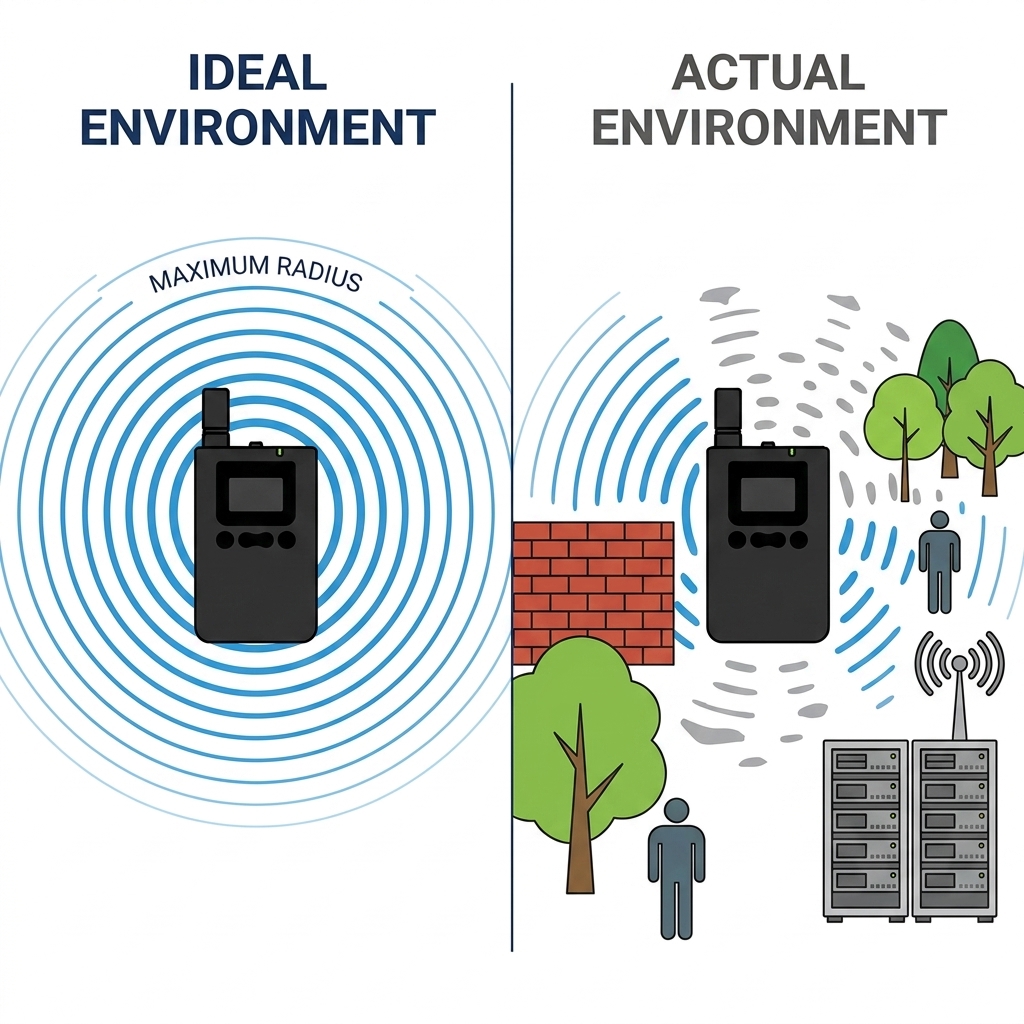
Many people mistakenly believe that the "maximum transmission distance" marked on a tour guide system is the actual usable coverage area, which is a common cognitive misunderstanding.
Signal range (also known as theoretical transmission distance) refers to the maximum distance a signal can travel under ideal laboratory conditions—completely unobstructed, zero electromagnetic interference, optimal antenna angle, and maximum transmission power. This value is usually tested by manufacturers under the most favorable conditions, such as an open playground or a room without any electronic devices.
Coverage area (also known as effective use distance) refers to the maximum distance that can ensure clear voice, no noise, and no interruption in actual use scenarios. This value is affected by various factors such as building structure, electromagnetic environment, crowd density, and weather conditions, and is usually only 30%-70% of the theoretical signal range.
For example, a tour guide system marked with a "maximum transmission distance of 200 meters" may only have an actual effective coverage of 60-80 meters in a reinforced concrete factory workshop; in a mountainous scenic spot with dense tree cover, it may be further reduced to less than 50 meters.
II. Comparison of Signal Performance of Mainstream Tour Guide System Technologies
Currently, wireless tour guide systems on the market mainly adopt three technical solutions, which have significant differences in signal range and coverage capability:
| Technology Type | Theoretical Signal Range | Actual Coverage Area | Wall Penetration Ability | Anti-interference Ability | Applicable Scenarios |
| UHF Ultra-High Frequency | 100-300 meters | 50-180 meters | Strong | Strong | Large scenic spots, factories, multi-story buildings |
| 2.4G Digital Frequency Hopping | 100-200 meters | 30-120 meters | Weak | Medium | Small and medium-sized exhibition halls, conference rooms |
| Bluetooth Low Energy (BLE) | 30-50 meters | 10-30 meters | Extremely weak | Weak | Small teams, close-range explanations |
1. UHF Ultra-High Frequency Technology
The UHF frequency band (usually 400-1000MHz) is the mainstream choice for professional tour guide systems at present. Due to its long wavelength, UHF signals have excellent diffraction capability and penetration, can easily pass through ordinary brick walls, wooden boards and crowds, and perform stably in complex environments.
Independent tests show that in a university campus with dense WiFi signals, the packet loss rate of UHF systems is less than 1%, while that of 2.4G systems is as high as 12-18%. In concrete steel structure factory workshops, the attenuation of UHF signals is about 60%, while the attenuation of 2.4G signals is as high as 85%.
2. 2.4G Digital Frequency Hopping Technology
2.4G is a globally available license-free frequency band, so products can be used in all countries around the world without applying for frequency authorization. Its advantage lies in the large number of channels, supporting dozens or even hundreds of teams to use simultaneously without crosstalk.
However, the 2.4G frequency band is also a public frequency band shared by devices such as WiFi, Bluetooth, and microwave ovens, and is susceptible to interference in places with complex electromagnetic environments. In addition, 2.4G signals have a short wavelength and poor penetration capability, and their attenuation is very obvious when encountering brick walls or metal structures.
3. Bluetooth Low Energy Technology
The advantages of Bluetooth technology lie in small device size, low power consumption and low cost. But its transmission distance is very limited, and its anti-interference ability and wall penetration ability are very poor. It is only suitable for small teams of less than 15 people to use in simple environments.
III. Key Factors Affecting Actual Coverage Effect
In addition to the technology itself, the following factors have a decisive impact on the actual coverage of tour guide systems:
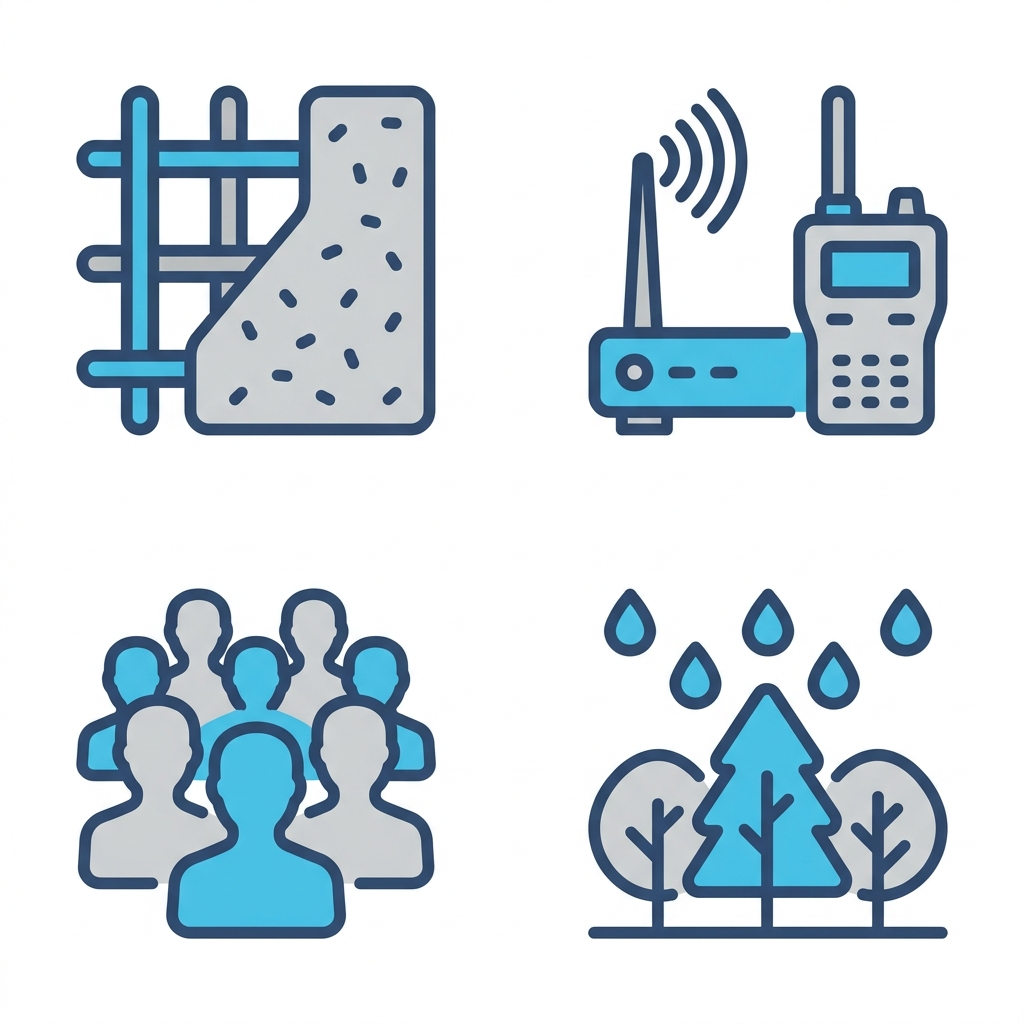
1. Building Materials and Structures
Different building materials have vastly different attenuation levels for wireless signals:
· Glass, gypsum board: attenuation of about 10-20%
· Brick walls, wooden boards: attenuation of about 30-40%
· Reinforced concrete walls: attenuation of about 60-70%
· Metal structures, elevators: attenuation of more than 90%
This is why the same device performs vastly differently in museums and factory workshops.
2. Electromagnetic Environment Density
In places with dense electronic devices such as airports, shopping malls, and convention centers, a large number of WiFi, Bluetooth, walkie-talkie and other signals will form a complex electromagnetic environment, seriously interfering with the normal operation of tour guide systems. Especially for 2.4G systems, the effective coverage in such environments will be significantly reduced.
3. Crowd Density and Obstruction
The human body has a strong absorption effect on wireless signals. When the team size is large, mutual obstruction between tourists will cause signal attenuation. Tests show that in teams of more than 50 people, the signal strength received by tourists at the end of the team may be only half of that at the front of the team.
4. Weather and Environmental Factors
In outdoor scenarios, rain, fog, trees, rocks and other objects will block and absorb signals. Especially on rainy days, moisture in the air will significantly attenuate 2.4G signals, while UHF signals are relatively less affected.
IV. Signal Coverage Requirements and Selection Suggestions for Different Scenarios
According to different usage scenarios, there are different requirements for the signal coverage capability of tour guide systems:
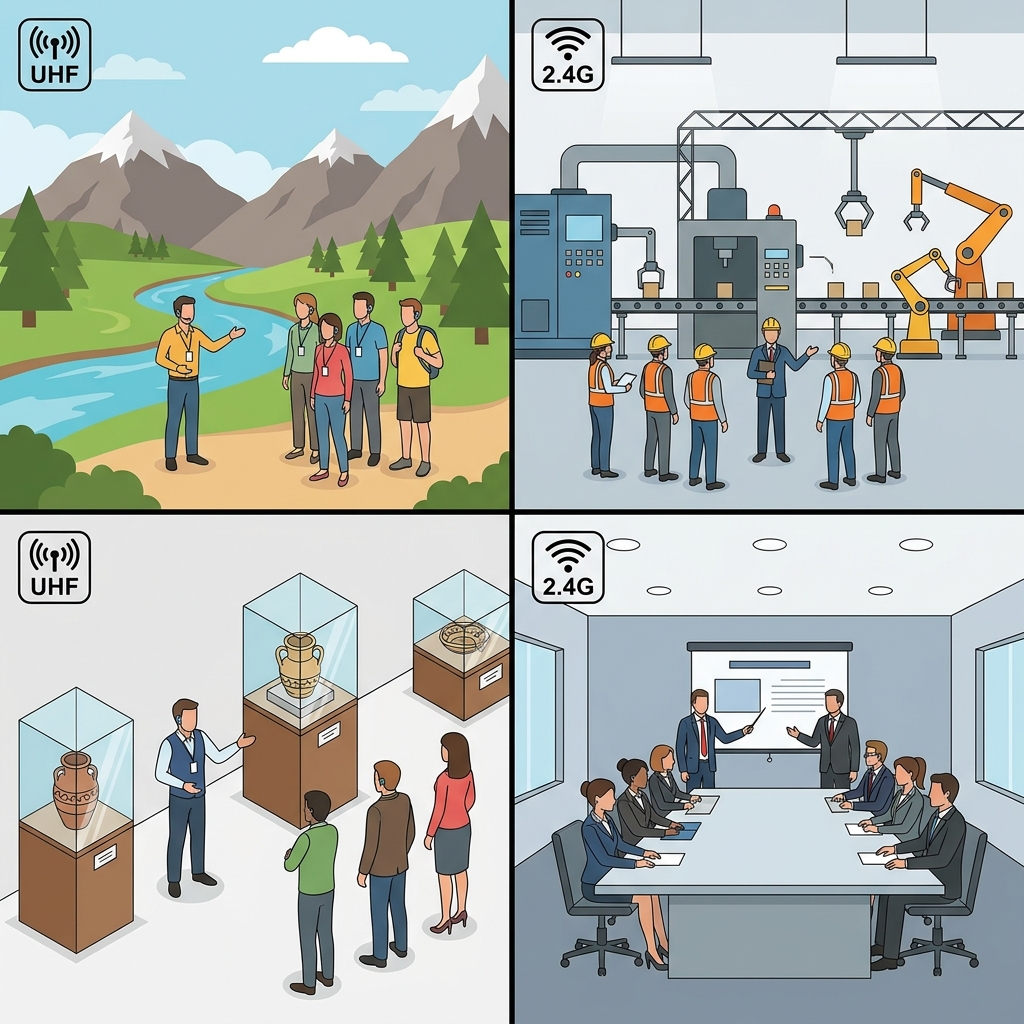
1. Large Outdoor Scenic Spots
· Coverage requirements: Stable transmission of 100-200 meters, able to cope with tree and rock obstructions and complex terrain
· Recommended technology: UHF ultra-high frequency
· Notes: Choose products with moderate transmission power and strong signal diffraction capability, and avoid using 2.4G systems
2. Factories and Industrial Parks
· Coverage requirements: Able to penetrate reinforced concrete walls and metal equipment, resistant to industrial electromagnetic interference
· Recommended technology: UHF ultra-high frequency
· Notes: Prioritize products optimized for industrial environments to ensure stable operation in environments with a large number of motors and frequency converters
3. Museums and Exhibition Halls
· Coverage requirements: Multiple teams can use simultaneously without crosstalk, and signals are isolated between adjacent exhibition halls
· Recommended technology: UHF or 2.4G (depending on the size of the venue)
· Notes: For large venues with multiple floors or multiple exhibition halls, it is recommended to choose systems that support partitioned explanations
4. Corporate Receptions and Meetings
· Coverage requirements: Stable transmission of 30-50 meters, clear sound quality, good confidentiality
· Recommended technology: 2.4G or UHF
· Notes: Choose products that support encrypted transmission to prevent the explanation content from being eavesdropped
V. How to Improve the Signal Coverage Quality of Tour Guide Systems
Even if a suitable technical solution is selected, the following tips can further improve the signal coverage effect:
1. Optimize antenna position: Keep the transmitter's antenna vertically upward to avoid being blocked by the body or other objects
2. Plan routes reasonably: Try to avoid large obstacles between tourists and the tour guide
3. Control team size: For teams with a large number of people, it is recommended to divide into small groups and use different channels
4. Check equipment regularly: Ensure that the batteries of the transmitter and receiver are fully charged, as insufficient battery power will lead to a decrease in transmission power
5. Avoid interference sources: Stay away from high-power electronic devices, WiFi routers and other interference sources as much as possible
Conclusion
Choosing a tour guide system with stable signals and reliable coverage can not only improve the visiting experience of tourists, but also demonstrate the professional image of the user. When purchasing, do not only look at the theoretical maximum transmission distance marked by the manufacturer, but also pay more attention to the performance of the product in actual scenarios.
As a professional tour guide system manufacturer with 19 years of industry experience, Yingmi has been committed to the research and development and innovation of signal technology. Its 008A team tour guide system adopts the 935MHz-955MHz global universal UHF frequency band, with a measured outdoor unobstructed transmission distance of up to 220 meters, and can maintain a stable connection even in environments with trees and low wall obstructions. The i7 self-guided tour system adopts the 860MHz-870MHz exclusive frequency band and supports 16-level signal strength adjustment, which can precisely control the coverage of each exhibition area and realize an immersive explanation experience of "sound follows people".
Whether it is outdoor guided tours in large scenic spots or factory workshop visits, Yingmi can provide customized signal coverage solutions according to different scenarios, allowing every listener to hear the explanation clearly.