A client from Germany sent me a message. In his email, he explained that he was responsible for procuring tour guide equipment for a UNESCO World Heritage-level museum complex. They were preparing for next year's international visitor season and urgently needed a batch of devices capable of two-way communication.
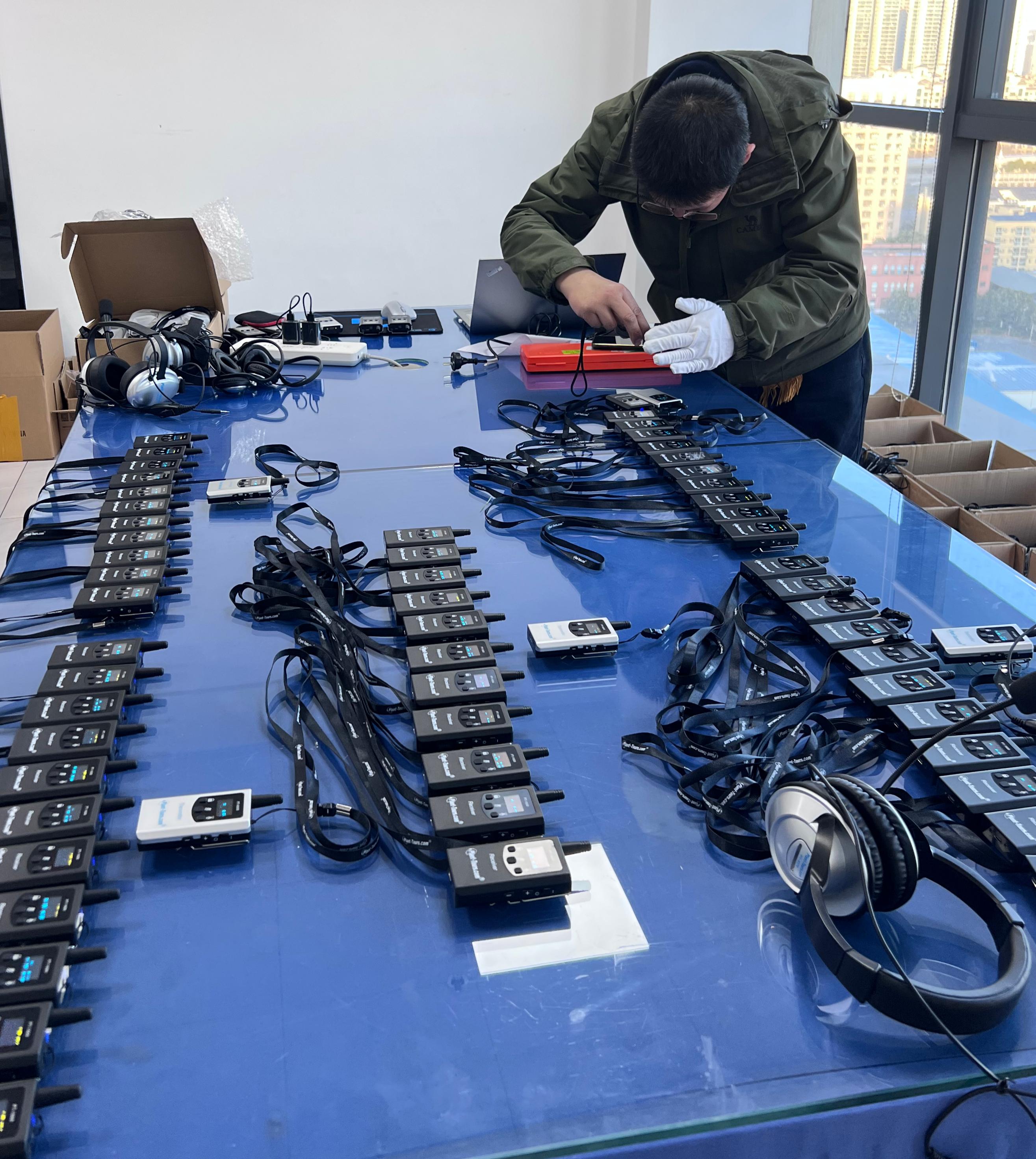
He asked a very direct question: "I need 1,000 units, all with the museum's joint logo, and the software needs adjustments—can you handle it?"
I replied: "We can handle it. But an order of this scale requires a production cycle. If it's convenient, I suggest you visit our facility at the final stage of the project, test the units on-site, and then we ship once you're satisfied."
Three months later, he arrived at the door of the Electrical and Mechanical Industrial Park in Hefei High-tech Zone.
Why Was He Willing to Wait Three Months?
This client had previously used various tour guide walkie talkie systems, but the experiences were less than ideal. Either the signal was unstable, frequently cutting out behind the museum's thick stone walls, or interaction was poor—visitors who wanted to ask questions had to shout, disrupting the entire tour atmosphere.
He told me: "I chose the 008B because it's a true two-way system. Visitors can press a button on their receiver to ask a question, and the entire group hears the Q&A. That's exactly the speaker tour guide experience we want."
But he also had concerns: Would custom logos and software adjustments affect product quality? Could 1,000 units maintain perfect consistency? These were questions he felt he could only settle by "seeing and testing them in person."
The Customization Cycle: What Happened During Those Three Months?
From requirement confirmation to delivery, it took a full three months. During this period, we focused on three main things:
Step 1: Requirement Confirmation
The client sent a detailed requirements document. On the software side, he needed the standard team tour mode, with all receivers synchronized, and a "raise hand to ask" function enabled, allowing visitors to interact at any time. For hardware, the devices needed the museum consortium's logo, including both German and English identifiers. Battery life had to last through a full 8-hour day of tours. For certification, CE and RoHS documentation was mandatory—a strict requirement for the EU market.
Step 2: Sample Creation
Our technical team first created a 3D appearance sample, sending photos and videos for confirmation. The client provided feedback—"move the logo up by two millimeters"—and we adjusted and sent another round for approval. Next came circuit board prototyping, software writing, and debugging. Every step was synchronized remotely with progress updates.
Step 3: Mass Production
After sample approval, the production line started running. 1,000 units were manufactured in batches, and each batch was tested. The client received production progress reports every two weeks.
The on-site acceptance after three months was the final step.
Day One: Unboxing, Spot Checks, and Field Testing
He arrived at our facility at 9 AM. Instead of heading straight to a meeting room, we went directly to the finished goods warehouse.
The 1,000 units were already packed into boxes according to the order requirements, neatly stacked. The client randomly selected three boxes, and we opened them on the spot.
The first check was the logo. On the black casing, the white logo was printed clearly and positioned accurately, with both German and English identifiers correct.
"Can we test this somewhere with the toughest signal penetration?" he asked.
We took the equipment to the furthest building in the factory complex. We placed the transmitter on the first floor. He took a receiver to the third floor and then circled around to the other side of the building. Despite several layers of concrete walls, the call remained clear, with no static or interference.
He also tested the "two-way questioning" function: press the button on the receiver, speak, and the sound instantly transmitted to all devices. Latency was virtually imperceptible.
"This function is critical for us," he said. "Visitors in museums often have questions. With our old equipment, they couldn't ask, so they just held it in. Now they can speak up anytime."
Day Two: Continuous Testing, Full Verification
Early the next morning, the client returned. He brought two notebooks—one for recording test results, one filled with blank labels.
By 4 PM, all equipment was repacked and ready. His two notebooks—one filled with test data, the other with device number labels we had printed for him—were complete.
Just before leaving, he said something that stuck with me: "I've seen countless brochures for system tour guide products, and every one of them looks great on paper. But you're the first who let me spend two days testing them one by one."
After Delivery: What Did the Client Say?
Four weeks after the equipment was shipped, we received a message. All 1,000 008B units were already in use, having served their first batch of international visitors. He wrote in his email:
"On the very first day of operation, we had an 80-person American student group. Kids were running everywhere, but the audio remained clear throughout. The group leader asked me where I bought this tour guide audio equipment. I told him: China, Hefei, a place called YINGMI."
He also attached a photo. At the museum entrance, 1,000 devices were neatly arranged in their charging cases, the joint logo on the casings glinting faintly under the lights.
Why Could the 008B Handle a 1,000-Unit Custom Order?
The client later asked: How did you dare to take on a custom order of this scale?
The answer is simple: Because we are the manufacturer, not a middleman.
Since our establishment in 2002, we've been rooted in the Electrical and Mechanical Industrial Park in Hefei High-tech Zone for over two decades. With more than 30,000 square meters of workshop space, our own R&D team, and complete production lines—this means custom requirements don't need to be relayed through layers, and we don't have to wait for supplier schedules.
Three months, a two-year warranty, 1,000 units—for us, it's not a question of "if we can," but "how we'll make it happen."
The Story Continues
Last month, this German client sent another photo. In the museum's gift shop, there was a new small display stand with a few 008B samples, next to a sign that read:
"This museum's audio guide equipment is custom-made by YINGMI."
Below the photo, he wrote: "Now visitors not only use our equipment, they also ask where they can buy the same model."
If you're also looking for a tour guide audio equipment system that truly supports two-way interaction, or if you have bulk customization needs, you're welcome to visit us in Hefei. Our workshop doors are always open. Test the equipment as much as you want, ask as many questions as you need.
1,000 units, 5,000 units—as long as the requirements are clear, we can make it happen.